In-Building DAS: Meeting Fire Code Signal Strength Requirements
When a firefighter enters a burning building, their portable radio is their lifeline. If the building's structure attenuates the radio signal below usable levels, that firefighter loses communication with incident command, cannot call for a mayday, and cannot coordinate with other crews. People die when this happens. That is why the International Fire Code (IFC) Section 510 and NFPA 1225 (Standard for Emergency Communications Systems) mandate that buildings maintain minimum radio signal strength for emergency responders throughout the interior, and why the Authority Having Jurisdiction (AHJ) can refuse to issue a certificate of occupancy until the building demonstrates compliance.
An Emergency Responder Radio Communication System (ERRCS), also known as an Emergency Responder Communication Enhancement System (ERCES), uses Bi-Directional Amplifiers (BDAs) and Distributed Antenna Systems (DAS) to boost public safety radio signals inside buildings where the structure itself blocks adequate coverage. This guide covers the code requirements, system architecture, frequency planning, testing protocols, and ongoing maintenance obligations that building owners and their integrators must understand.
IFC Section 510 and NFPA 1225: What the Code Requires
IFC Section 510 (Emergency Responder Radio Coverage in Buildings) establishes the fundamental mandate: all new buildings and existing buildings undergoing major renovation must provide radio coverage for emergency responders throughout the building. The specific signal strength requirements and coverage percentages vary by IFC edition and local amendments, but the IFC 2021 edition establishes the following baseline thresholds.
| Requirement | IFC 2021 Specification | Notes |
|---|---|---|
| Inbound Signal (Downlink) | -95 dBm minimum | Signal from outside (dispatch/repeater) to portable radio inside building |
| Outbound Signal (Uplink) | -100 dBm minimum | Signal from portable radio inside building to outside infrastructure |
| General Building Area Coverage | 95% of each floor | Measured on a grid per floor, not aggregate across building |
| Critical Area Coverage | 99% of area | Stairwells, elevator lobbies, fire command centers, standpipe locations |
| Delivered Audio Quality (DAQ) | DAQ 3.0 minimum | Speech understandable without repetition (per TIA-603) |
| Battery Backup Duration | 12 hours standby + 2 hours full operation | Per NFPA 1225; some AHJs require 24 hours standby |
| Annual Testing | Required, with AHJ notification | Must be performed by qualified personnel; results submitted to AHJ |
NFPA 1225 (which absorbed the former NFPA 72 Chapter 24 requirements for two-way radio communications) provides additional detail on system design, installation, and testing. It specifies that the system must not interfere with public safety radio systems outside the building (a critical constraint that drives isolation requirements) and must include monitoring, supervision, and battery backup. Local AHJ amendments frequently add requirements beyond the IFC baseline. Some jurisdictions require -90 dBm inbound (stricter than the IFC's -95 dBm), require 24-hour battery backup, or mandate specific frequency bands. Always verify local amendments before designing a system.
BDA vs. DAS: System Architecture Options
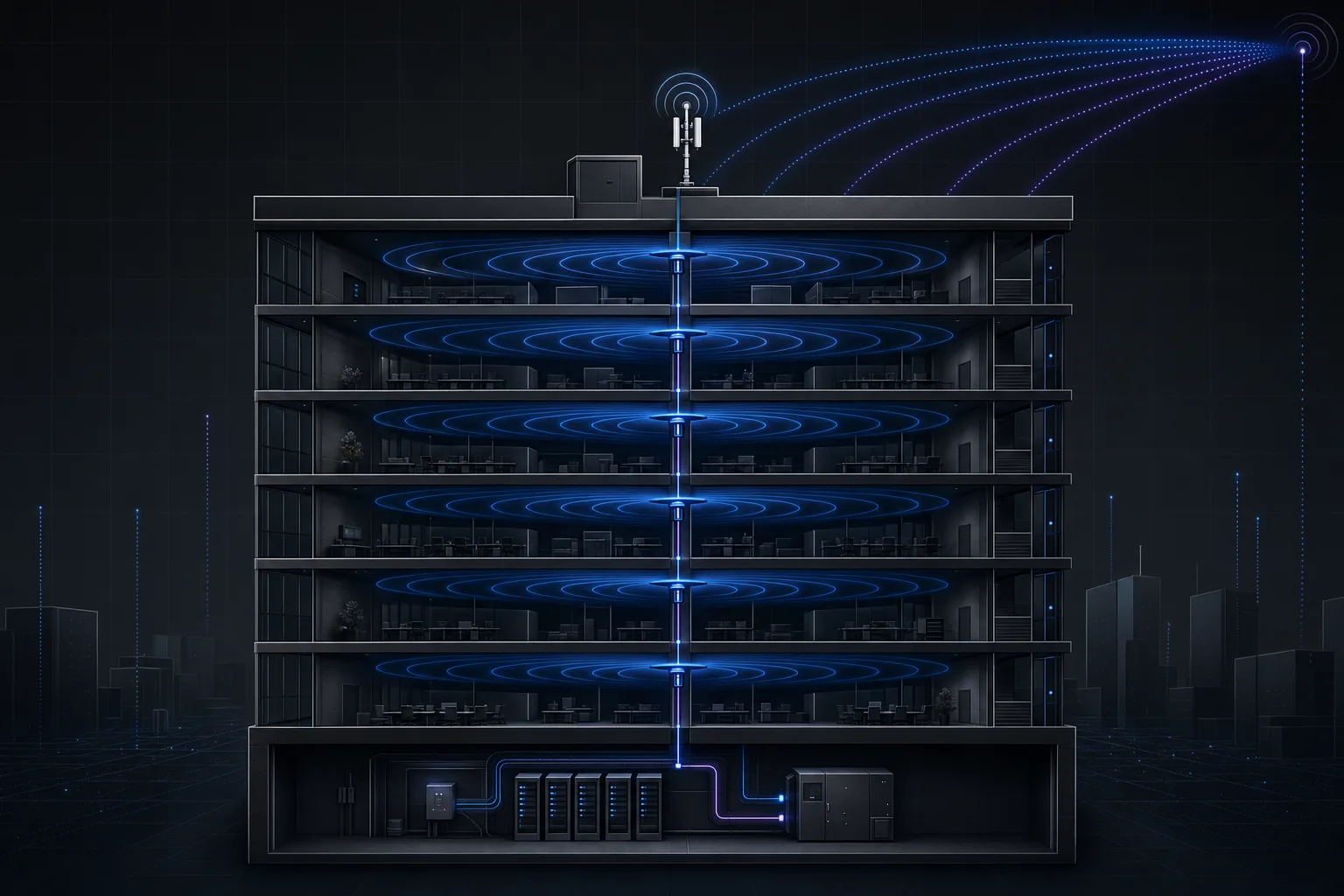
A Bi-Directional Amplifier (BDA) is the core active component that receives the public safety radio signal from an outdoor donor antenna, amplifies it, and distributes it through an indoor antenna network. The term "BDA" refers specifically to the amplifier. "DAS" (Distributed Antenna System) refers to the complete antenna distribution network. In practice, an ERRCS installation is a BDA feeding a DAS, and the terms are sometimes used interchangeably in the field.
The system architecture begins at the donor antenna, typically mounted on the building roof with line-of-sight to the nearest public safety radio tower or repeater site. The donor antenna feeds coaxial cable down to the BDA, which is installed in a dedicated, fire-rated enclosure with monitored power, environmental controls, and battery backup. The BDA amplifies the signal in both directions (downlink from tower to building, uplink from portable radio to tower) and distributes it through the indoor DAS.
The indoor DAS can be implemented with two fundamental approaches: passive and active.
- Passive DAS. Uses coaxial cable (typically 1/2-inch or 7/8-inch plenum-rated), splitters, directional couplers, and passive antennas to distribute the signal from the BDA throughout the building. No active electronics in the distribution network. Simple, reliable, and cost-effective for buildings under approximately 200,000 square feet. The limitation is coaxial cable loss: 1/2-inch coax loses approximately 3.9 dB per 100 feet at 800 MHz, which constrains distribution distance. Every splitter adds 3.5 dB of loss (2-way) or 6 dB (4-way). In large buildings, the cumulative cable and splitter losses can consume the BDA's output power before reaching remote antennas.
- Active DAS / Fiber-Fed Remotes. Uses fiber optic cable to transport the RF signal from the BDA head-end to remote units (RUs) distributed throughout the building. Each remote unit converts the optical signal back to RF and feeds a local antenna. This architecture overcomes the distance limitations of coaxial distribution and is the standard approach for buildings over 200,000 square feet, multi-building campuses, and high-rise structures. Fiber-fed remotes add cost and complexity (each RU requires local power and monitoring) but provide consistent signal levels across the entire building regardless of distance from the BDA.
Public Safety Frequency Bands
Public safety radio systems operate across multiple frequency bands, and the ERRCS must support whichever bands the local agencies use. The four primary bands are:
- VHF (136-174 MHz). Used by many rural fire departments and some legacy municipal systems. VHF propagates better through vegetation and open terrain but requires larger antennas. Building penetration loss is moderate.
- UHF (380-512 MHz). Common for municipal police and fire in urban areas. UHF balances building penetration with antenna size. Many legacy analog systems and some P25 digital systems operate in this band.
- 700 MHz (764-776 / 794-806 MHz). The public safety broadband allocation, including the 700 MHz narrowband channels used by many P25 Phase II trunked radio systems. This is an increasingly common requirement as agencies migrate to digital systems.
- 800 MHz (806-869 MHz) and FirstNet (Band 14, 758-768 / 788-798 MHz). The 800 MHz band hosts many P25 systems, and FirstNet (Band 14) is the dedicated nationwide public safety LTE broadband network. Increasingly, AHJs are requiring FirstNet/Band 14 support in addition to traditional land mobile radio (LMR) bands, particularly in jurisdictions where first responders use FirstNet-enabled devices for data, video, and push-to-talk.
Donor Antenna Isolation: The Most Critical Design Parameter
The BDA amplifies signals in both directions. If the indoor signal leaks back to the donor antenna (or vice versa), the amplifier creates a feedback loop that oscillates, interferes with the public safety radio system, and can trigger FCC enforcement action. The isolation between the donor antenna and the indoor antenna system must exceed the BDA's gain by at least 15 dB (the "isolation margin"). For a BDA with 80 dB of gain, you need at least 95 dB of isolation. This is achieved through physical separation (vertical and horizontal distance between donor and nearest indoor antenna), directional donor antennas (Yagi or panel antennas aimed at the radio tower), and building shielding. Measure isolation before installing the BDA. If you cannot achieve adequate isolation, reduce BDA gain or relocate the donor antenna. An oscillating BDA is worse than no BDA at all because it actively disrupts public safety communications.
Initial Testing and Annual Compliance
Before the ERRCS can be accepted, a comprehensive grid-based signal strength survey must be performed. The IFC requires testing on every floor, using a calibrated portable radio or signal strength meter, at grid points spaced no more than 40 feet apart (20 feet in critical areas). Each measurement point is recorded with its location and signal level in dBm. The results must demonstrate that 95% of the general floor area and 99% of critical areas meet the minimum signal threshold.
The test protocol also requires verification of DAQ (Delivered Audio Quality) at representative locations throughout the building. DAQ testing involves actual voice transmissions on the public safety frequencies, evaluated by trained personnel using the TIA-603 DAQ scale. A DAQ score of 3.0 means speech is understandable without repetition, which is the minimum acceptable level for emergency communications.
Annual testing is mandatory under both IFC and NFPA 1225. The annual test must repeat the grid-based survey to verify that the system still meets coverage requirements (building modifications, new tenants, furniture changes, and equipment aging can all degrade performance). Battery backup must be tested under load for the full rated duration. All BDA components, antennas, cables, and connectors must be inspected for physical damage. The AHJ must be notified prior to testing and may observe or require submission of the test report. Failure to perform annual testing can result in the AHJ revoking the building's occupancy permit.
System Monitoring and Battery Backup
NFPA 1225 requires that the ERRCS be monitored by a supervising station or the building's fire alarm control panel. Monitored conditions include: BDA power failure, BDA malfunction, antenna system fault, low battery, and loss of signal from the donor antenna. These supervisory signals must be treated as trouble conditions and transmitted to the monitoring station within 200 seconds, consistent with NFPA 72 requirements for fire alarm supervisory signals.
Battery backup requirements are stringent. NFPA 1225 mandates 12 hours of standby power followed by 2 hours of full operational capacity. This means the batteries must power the entire BDA and DAS system (including all active remote units) for a minimum of 14 hours total. Some jurisdictions extend this to 24 hours of standby. Battery calculations must account for the actual power consumption of all active components, not just the BDA head-end. For fiber-fed active DAS systems, each remote unit draws 10-50 watts, and a large building may have dozens of remotes. The battery plant for a large ERRCS can be substantial: a system drawing 500 watts for 14 hours requires 7,000 Wh of battery capacity, which translates to approximately 600 Ah of 12V VRLA batteries or a significantly smaller LiFePO4 installation.
The BDA enclosure must be installed in a NEMA-rated or fire-rated room or cabinet with environmental monitoring. Temperature extremes degrade both BDA performance and battery life. A UPS or dedicated electrical circuit with generator backup is recommended to minimize battery cycling and extend battery lifespan.
Common Design and Installation Pitfalls
- Inadequate donor signal. If the outdoor donor antenna cannot receive a strong enough signal from the public safety radio tower, the BDA cannot amplify what is not there. Always perform a rooftop signal survey before committing to a design. If the donor signal is below -75 dBm, you may need a high-gain donor antenna, a more favorable antenna location, or coordination with the public safety radio system operator.
- Ignoring uplink requirements. Many designers focus on the downlink (getting signal into the building) and neglect the uplink (getting the firefighter's portable radio signal back out). A firefighter's portable radio transmits at 1-5 watts, far less than the base station or repeater. The uplink is almost always the weak link and must be verified separately during testing.
- Insufficient isolation margin. BDA oscillation is the most common cause of system failure and FCC complaints. Design for at least 15 dB of isolation margin and verify with measurements before energizing the BDA. Document the isolation measurement as part of the commissioning package.
- Forgetting the battery load test. Batteries degrade over time. A battery bank that provided 14 hours of backup at installation may only provide 8 hours three years later. Annual load testing per NFPA 1225 catches this degradation before it results in a code violation or, worse, a system failure during an actual emergency.
Conclusion
In-building public safety radio coverage is not an optional amenity. It is a life-safety code requirement that directly affects whether emergency responders can do their jobs inside your building. The code requirements are specific and measurable: defined signal strength thresholds, coverage percentages, audio quality minimums, battery backup durations, and annual testing obligations. The engineering is straightforward but unforgiving: inadequate donor signal, insufficient isolation, or undersized battery backup will result in a failed acceptance test and a delayed certificate of occupancy.
Zimy Electronics designs, installs, and maintains ERRCS/DAS systems that comply with IFC Section 510, NFPA 1225, and local AHJ requirements across all public safety frequency bands including FirstNet Band 14. Our RF engineers perform the initial signal surveys, design the BDA and antenna distribution network, coordinate with the AHJ and the public safety radio system licensee, commission the system with comprehensive grid-based testing, and provide the ongoing annual testing and maintenance required to keep the system in compliance. From a single-building BDA installation to a multi-building campus fiber-fed DAS, we ensure your building meets the signal strength requirements that keep first responders connected when it matters most.